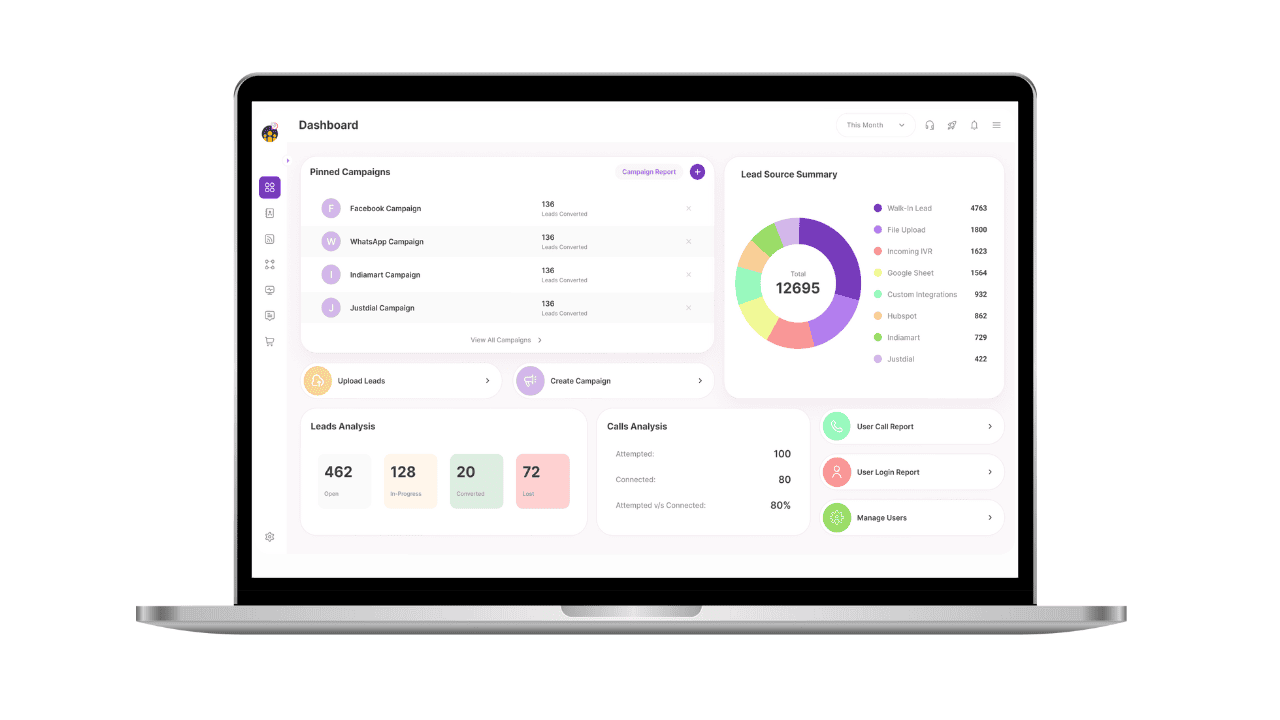
With features like email marketing automation, customer segmentation, and campaign tracking, dealerships can create targeted promotions, deliver personalized messages, and monitor the success of their marketing initiatives. This ensures that marketing efforts are more effective and aligned with customer preferences.
CRM Automobiles streamline various operational aspects of a dealership, from managing inventory and handling customer inquiries to processing transactions and scheduling service appointments.
Automating routine tasks and centralizing customer interactions, a CRM for automotive enhances overall operational efficiency. Dealerships can reduce manual effort, minimize errors, and ensure that their processes are smooth and well-coordinated.
Before finalizing a CRM for car dealership, it’s essential to assess your specific business needs. Begin by pinpointing the main challenges you face and the goals you aim to achieve with the CRM.
Common needs for car dealerships include lead management, customer segmentation, service scheduling, inventory management, and sales tracking.
List these requirements to ensure that the CRM for car dealerships you choose aligns with your operational goals and can address your unique challenges.
A CRM for automotive industry should be intuitive and easy to use. Since dealership staff may have varying levels of technical proficiency, a user-friendly interface is crucial for ensuring quick adoption and minimizing the learning curve.
Choose a CRM that features a clean, organized dashboard and intuitive navigation.
Consider requesting a demo or trial version to assess the system’s usability and ensure it meets the needs of your team.
Your CRM for automotive should integrate seamlessly with other systems and tools you use in your dealership.
This includes integrating with inventory management systems, marketing platforms, and accounting software. Effective integration ensures seamless data flow between systems, reducing manual data entry and minimizing errors.
Check if the CRM for car dealership you selected supports integrations with popular tools or has APIs that allow for custom integrations.
Every dealership has its unique processes and requirements. Therefore, a CRM for car dealerships should offer customization options to tailor the system to your specific needs.
Look for a CRM that allows you to customize fields, workflows, and reports to align with your dealership’s operations.
Customization features enable you to adapt the CRM to fit your business model and ensure it supports your specific sales and service processes.
Lead management is a vital component of any CRM designed for car dealerships. The system should provide robust tools for capturing, tracking, and nurturing leads.
Additionally, the CRM should support sales management by providing tools for tracking sales activities, managing opportunities, and forecasting sales performance.
Excellent customer service is vital for maintaining strong relationships with your clients. A CRM for car dealership should include features that enhance customer service, such as automated appointment scheduling, service reminders, and easy access to customer history.
Furthermore, consider the level of support provided by the CRM vendor. Ensure they offer responsive customer support, training resources, and regular updates to address any issues and keep the system running smoothly.
In today’s fast-paced environment, mobility is essential. A CRM for car dealerships should offer mobile accessibility, allowing your sales and service teams to access critical information and manage tasks from their smartphones or tablets.
Mobile access ensures that your team can stay connected and productive, even when they are away from the office or on the road.
Leveraging data-driven decision-making is a major benefit of using a CRM for car dealerships. The system should provide comprehensive reporting and analytics tools to help you track performance, analyze trends, and make informed decisions.
Look for CRM for car dealerships that have features like customizable reports, sales analytics, and dashboards that offer insights into key metrics such as lead conversion rates, sales performance, and customer satisfaction.
As your car dealership grows, your CRM needs may evolve. Choose a CRM for automotive that is scalable and flexible to accommodate future growth. The system should be able to accommodate growing data volumes, additional users, and expanded functionalities without needing a complete overhaul.
Finally, consider the cost of the CRM for car dealerships and evaluate its return on investment (ROI). While it’s important to stay within budget, it’s equally crucial to assess the value the CRM provides.
Compare CRM pricing by evaluating factors like licensing fees, implementation costs, and ongoing maintenance expenses. Evaluate the potential ROI by analyzing how the CRM will impact your sales, operational efficiency, and customer satisfaction.
Founded in 2020 with a vision to empower small and medium-sized businesses, NeoDove has rapidly emerged as a leading CRM solution for the automotive industry.
Our deep understanding of the unique challenges faced by dealerships has driven us to develop a platform that not only manages leads but also accelerates sales and enhances customer satisfaction.
Backed by Vyapar, India’s leading GST billing and accounting software, NeoDove combines cutting-edge technology with industry expertise to deliver unparalleled value.